Saturday, May 31, 2008

Busy busy ..

March, April and May are peak seasons for butterflies and I have been out butterflying and mothing non-stop in Malaysia for the past three months. During the last 3 months, I have seen more lifers and rare species than my other outings.

Now you know why I have not been blogging for the last 2 months ;-) However, I am going to make up for it by sharing some of the prettiest and rarest butterflies and moths from Singapore and Malaysia !

I will start with a local species, Euthalia adonia (Green Baron), my nickname on the web. I have been looking high and low for this caterpillar for some time now with no success. Last month, when I came back from a butterfly trip from Malaysia, my wife told me she has an interesting caterpillar for me. Low and behold it is the caterpillar of the Green Baron butterfly !
Wai Yen was rearing the Painted Jezebel caterpillars and she has been collecting the leaves of Dendropthoe and Macrosolen from plants around our condominium for the caterpillars. While washing the leaves, she found this spiny caterpillar feeding on the leaf of Macrosolen.


The caterpillar of the Green Baron, like those from the tribe Adoliaditi (The Baron, Horsfield's Baron, Archduke ..) has a single subdorsal row of very long, horizontal projecting, delicately branched spines. 9 days after the caterpillar pupated, a beautiful female emerged !


Peak season for butterflies is also the best time for wasps and other butterfly predators. The Neostauropus alternus, Enpinanga borneensis and the Blue Nawab caterpillars I was breeding were all parasitized :-(

Now back to species from Malaysia. I shall start a few intersting hawk moths which most of us have never seen.

1. Amplypterus panopus : This hawk moth has long and slender forewings and its caterpillar feeds on the leaf of Durian ! Angie Ng found a caterpillar of this hawk moth in Ubin.

2. Amplypterus mansoni : A. mansoni is much rarer than A. panopus and can be mistaken as A. panopus. 3. Ambulyx tattina
4. Marumba cristata
That's it for now. In my next post, I will show some rare butterfly from the Fraser's Hill.

Sunday, May 11, 2008

Euthalia adonia pinwilli (Green Baron)

Name : Euthalia adonia pinwilli
Common Name : Green Baron
Family : Nymphalidae, Nymphalinae
Larva host plant : Macrosolen cochinchinensis ( Loranthaceae )

Female


Life History Record

Date : 17 April 2008 by Wong Wai Yen
Location : West Cove Condominium, Singapore.

Host Plant : Macrosolen cochinchinensis


Caterpillar :

Adult : female

Friday, April 11, 2008

Moth - Drepana fulvata Snellen, 1876, Tijdschr

Name : Drepana fulvata Snellen, 1876, Tijdschr.
Family : Drepanidae
Subfamily : Drepaninae
Reference : The Moth of Borneo, Vol 8, Plate 3

Record :
Date : Jan 12 2008
Location : Neo Tiew area
Host Plant : Nephelium lappaceum - Rambutan
Pupation period : 6 days (7 Dec 2008 - 13 dec 2008)


Caterpillar :
Pupa :


Thursday, April 3, 2008

Ant like moth caterpillar

When I was at Pulau Ubin last month, I chanced upon a batch of ant-like caterpillars feeding on Melastoma malabathricum.

When disturbed, it will lift up its head and waves its legs. I found out later from Tzi Ming that this is the caterpillar of the Neostauropus alternus, a drab brown moth ;-(

A few of my hawk moths Caterpillar has pupated!They are (from the top) :
-Psilogramma menephron
-Enpinanga borneensis
-Eupanacra elegantulus or E. mydon.

You can see photo of P. menephron and E. borneensis in my earlier post.

This is how the E. elegantulus(mydon?) caterpillar looks like

Thursday, March 27, 2008

The Nawab

Every time I see a Plain Nawab (Polyura hebe) caterpillar, I just have to take photo of it, even though I already have hundreds of similar shots. I am not sure if it is because I am fascinated by the Dragon-like armoured head, the way it parks itself on the 'landing pad' it meticulously weaved together or the light green crescent patterns along its abdomen. Probably all of the above ;-) So last week when I visited Mt Faber Park and saw a few early instar Plain Nawab caterpillars, instinctively I stop and took a few shots of them.

The early instar of the Plain Nawab caterpillar unlike that of the later instar, has black color head (instead of green) and green body without any patterns.

As I was about to move on, I noticed one of the caterpillars has a slight reddish horns.
Interesting ! Again without thinking I took a few more shots and continued my journey up the steps along the Marang Trail.

Last night, when I was sorting through my photos, deciding which to delete and which to keep, I noticed there is something different about the 'red-head' Plain Nawab caterpillar from Mt Faber.

It is NOT a Plain Nawab caterpillar! It is the caterpillar of the Blue Nawab (Polyura schreiber).

Yahoo!

So what is the big deal you ask? First, the Blue Nawab caterpillar is uncommon. More important is the fact that this one is found feeding on Saga (Adenanthera pavonina) instead of its normal food plant - Rambutan (Nephelium lappaceum). This validates BIG's 2001 finding that Adenanthera pavonina is an alternative host plant for Blue Nawab.

Three cheers for BIG !!

Tuesday, March 25, 2008

This is the season for moth!

This is definitely the season for moths. Over the last few days I have received numerous sms and pm from friends and GCS members asking if I want to adopt moth caterpillars which are defoliating their plants. Yesterday, I spotted 2 hawk moth caterpillars during my morning walk at Clementi Woods Park. Since I am left with 1 skipper caterpillars under my care, this is the perfect time to switch over to rearing moth caterpillars.

I am now rearing 4 hawk moth caterpillars and another very interesting moth caterpillar which I have no idea what it is.

Below are two of the hawk moth caterpillars I am rearing:

1. Psilogramma menephron : It has just changed color and will go into pre-pupa stage very soon.

2. Enpinanga borneensis : It is in its last instar and will go into pre-pupa stage in the next 2 to 3 days.

Sunday, March 23, 2008

A green Duffer pupa !

The other Duffer caterpillar (#C16b) pupated a few days ago and it is green in color!
The Duffer caterpillars obviously can sense the color of their surroundings and adapt to it.
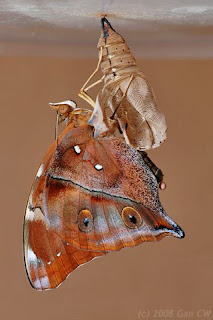
#C7 Autumn Leaf emerged after 9 days of pupation period. Below is a photo showing it drying its wings.