I just came back from our year-end retreat at Fraser's Hill. It is another fantastic trip - nice accommodation, good food, great companion and better than expected butterfly and moth sightings.
This time we stayed at the Buona Vista Bungalow, which is located at Girdle Road, more widely known as the Telecom Loop.
 The bungalow has a lovely garden. I could see sunrise right from my room on the 2nd floor.
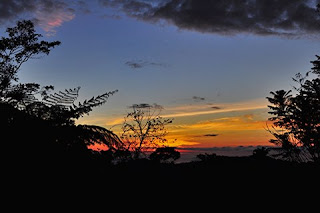
Even though this is the raining season, the weather was pretty good, it drizzles only in the evening so we get to do birding and look for butterfly during the day and moth during the night. Not bad considering this is the monsoon season !
We managed to spot some rare butterflies just from the road around Fraser's Hill !
1. Enispe intermedia - The Red Caliph

This is a lifer for me ! We were walking towards a bungalow when I spotted this butterfly. It is the size and shape of a Saturn (
Zuexidia amethystus) but with dull reddish brown on the underside. I knew immediately I have a gem ! According to C&P4, this species is confined to heavy forest and has been taken on fruit bait at altitudes up to 4500 ft (~1370m). This one is spotted at 1500m.
2.
Elymnias patna - The Blue Striped Palmfly
All Elymnias other than
E. hypermnestra and
E. panthera are rare and confined to heavy forest.
E. patna is usually confined to the hills and can be mistaken for a Euploea. The only give away is the typical Elymnias striations at the tornal area of the hindwings. In fact it was Celine and Bee Choo who alerted me to this 'Crow' resting below a bridge along the new road leading to Fraser's Hill. It was exactly 1 year ago when I first came across this butterfly also at Fraser's Hill !
+200712-MYFH_1954.jpg)
3.
Kaniska canace - The Blue Admiral
We were very fortunate to chance upon this friendly Admiral along the Richmond road. The Blue Admiral is usually a very shy and skittish butterfly and rarely stays long enough to be photographed. This individual was flying up and down the Richmond road and allowed me to get close with my 105mm lens for a few shots.
3. Taneacia godartii - The Malay Count
 We were at walking towards the Jeriau waterfall when Jasmine spotted a bunch of red berries. I noticed a butterfly with a broad bright blue marginal border on the hindwing feeding on the berries. If this were in Singapore, it will be the Horsfield Baron. In Malaysia however, there are at least 4 butterflies with similar blue border ! Fortunately, we were able to see the underside which shows it is the male of The Malay Count.
4. Cyrestis maenalis
 This is the mapwing that you will see at Frase's Hill (1500m). It can be seen along roads, at Jeriau waterfall and even in the garden of bungalows at Fraser's Hill ! This one is photographed at the garden of the Sri Intan apartment (using the LiveView of my D90). According to C&P4, 'C. nivea may be taken at moderate elevations, and probably does not occur much above 2000ft (~600m). Above this altitude it is replaced by C. maenalis."


 Pupa :
 Adult :

 OK, so we have Malayan Zebra, Pendlebury's Zebra, Blue Jay, Five Bar Swordtail. No big deal ! Look again, what is that butterfly that looks like a faded Five Bar Swordtail ? It is a Four Bar Swordtail (4BS)- Pathysa agetes !
  I have been looking for 4BS ever since Laurence Leong showed me a photo of 4BS photos taken at FS. I didn't expect to see any exotic butterfly this trip but there it was sitting there waiting for me ! That sighting alone made the trip worth while, but that is not all...
 This must be one of the most beautiful Lycaenid in Malaysia. On closer examination, I realised that bush which they are busking on is Polygonum chinesis, the host plant of Purple Sapphire !

 Red-spot Jezebel - Delias descombesi
 Yellow Jezebel - Delias baracasa


 As you can see in the photo above, there were very few moths on the screen. However, we did get a few big ones - the beautiful Owl Moth -Brahmaea hearseyi which Vilma was admiring and stealth bomber like Acosmeryx shervillii which Celine was trying to photograph.
 and this is the mystery moth !
 As it turns out, this is an undescribed Eupterote species which is not uncommon at Fraser's Hill.
-200812-MYFH-N1806-480.JPG)

 All in all we have 1 new Erebus record for Malaysia, 1 undescribed Eupterote species, 1 saturnid, 14 sphingids !

 P. foetida growing on railing
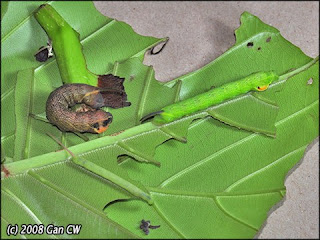
 The adult emerged 8 days after the caterpillar pupated
 3. Moth caterpillar on Ricinus communis - Castor Oil plant.

 If you think the caterpillar looks weird, wait till you see the pupa ! Read more about it
+200712-MYFH_1954.jpg)