Monday, February 6, 2012

Death-head Hawk Moth

Name : Acherontia lachesis (Fabricius, 1798)
Family : SPHINGIDAE Latreille, 1802
Subfamily : Sphinginae Latreille, [1802]
Tribe : Acherontiini Boisduval, [1875]
Larva host plant :Clerodendrum paniculatum (Labiatae), Stachytarpheta indica (Verbenaceae)


Acherontia lachesis-20120206_DN49


Life History Record :
- ?? ?? ????: Larva from Fraser’s Hill, feeds on Clerodendrum sp.
- 11 Jan 2012 : Larva from Lyndi Whye, feeds on variegated Stachytarpheta indica

Date : Jan 2011
Location : Namly Avenue, Bukit Timah, Singapore.
Host Plant : Stachytarpheta indica (Verbenaceae)

5th instar:Acherontia lachesis-20120115_DS42

Pre-pupa:Acherontia lachesis-20120118_DN41

Just pupated:Acherontia lachesis-20120118_DN46

Pupa:Acherontia lachesis-20120119_DN43

Pupation period : 18 days.

Adult:Acherontia lachesis-20120206_DN43

Sunday, February 5, 2012

Visitors to my garden

Here are some recent visitors to my high rise garden.

2011 Nov : A female Peacock Royal (Tajuria cippus) fluttering around my Sui Mei plant which has Dendrophthoe pentandra growing on it.

GanGarden-20111231_DS01-800

2012 Jan : A female Painted Jezebel (Delias hyparate) ovipositing on Dendrophthoe pentandra.

GanGarden-20120128_DN45-480


2012 Feb : A Chocolate Pansy (Junonia hedonia) was fluttering around my 5th floor garden for 30 mins.  I am surprised to find Chocolate Pansy up on a high rise garden because Chocolate pansy usually flies closed to the ground. I hope it laid some eggs on its hostplant which I have growing in my garden.

ChocPansy-GanHouse-20120204_D36-480


2012 Feb ; I found this Cleora sp. moth, measuring 40mm across on the wall outside my apartment.  It stayed there for 3 days before disappearing !Cleora sp-OutsideGanHouse-20120201_DS07-480

Friday, December 30, 2011

Butterfly Species #18 in my garden

Today, my Mrs alerted me to a 'large black butterfly' hovering over above me. I looked up and there is a King Crow (Euploea phaenareta castelnaui) circling over my garden !

The crow must have came from West Coast Park where there are many Pong Pong trees (Cerbera odollam), its larva host plant. It must have been attracted by my Dill plant. On 14 Dec, I spotted a Dark Glassy Tiger (Parantica agleoides agleoides) circling my dill plant and it stayed for 2 days before disappearing.

20111214_DSC_4062-640

Tuesday, December 20, 2011

Eupanacra elegantulus (Herrich-Schaeffer, [1856])

Name       : Eupanacra elegantulus (Herrich-Schaeffer, [1856])
Family      : SPHINGIDAE Latreille, 1802
Subfamily : MACROGLOSSINAE Harris, 1839 
Tribe        : Macroglossini Harris, 1839
Larva host plant : Alocasia,
Diffenbachia, Anthurium, Philodendron
Female : Mar 2008 Singapore 

Eupanacra elegantulus-200803-N8173-640
Female : Mar 2008 Singapore 

Eupanacra elegantulus-20090109_2656-640
Jan 2009 Singapore

Eupanacra elegantulus-200803-N8173-640 
Male : Mar 2008 Singapore

20111220_DS02 
Male : Dec 2011 Singapore

Reference : The Sphingidae of Southeast-Asia


Life History Record :
- Dec 2011Diffenbachia
- May 2009Colocosia Black Magic
- Apr 2009Anthurium
- Jan 2009 - Philodendron selloum
- Mar 2008Alocacsia and Diffenbachia


Date : 3 Dec 2011
source : Gan
Location : MacRitchie Reservoir, Singapore
Host plant : Diffenbachia

20111204_DS1320111204_DS1720111213_DS0520111220_DS02


Date : 25 May 2009
source : GCS member “wolfman”
Location : Along Pasir Panjang Road, Singapore
Host plant : Colocasia Black Magic

Eupanacra elegantulus-20090521_1787-640 

Date : 28 Mar 2008
Source : Ling Chai Joo, ZMPS Parent volunteer
Location : Zhong Hua Primary School (ZMPS), Singapore
Host Plant : Alocasia and Diffenbachia amoena (Dumbcane)

Ovum ~ 1.3mmegg-Eupanacra elegantulus-200803-N6103 
2nd Instar larva ~ 14.5mm
Cat2-Eupanacra elegantulus-200803-N6105

Larvae T-B : Prepupa, 5th, 3rd instarcat-DSC09580-640

Final instar pre-pupa larva  :cat5-Eupanacra elegantulus-200803-N6110

Pupa :
Pupa-Eupanacra elegantulus-200803-N8192-640 
Imago (male) :Eupanacra elegantulus-200803-N8173-640
Eupanacra elegantulus-200803-N8210-640


Date : 9 Jan 2009
Source : Mubaraka, GCS member.
Location : Along Holland Road, Singapore.
Host Plant : Araceae - Philodendron selloum

Philodendron selloum

Larva : 5th instarEupanacra elegantulus-20090109_0666-480
Pre-Pupa : The caterpillar build a ‘cocoon’ Prepupa-Eupanacra elegantulus-20090109_2344-640 
That is how the caterpillar looks like before it change into Pupa.  it is now about 0.6 of its original sizePrepupa-Eupanacra elegantulus-20090109_2351-640
Pupa : ~ 39mmPupa-Eupanacra elegantulus-20090109_2375-640
Adult (male):Eupanacra elegantulus-20090109_2665-480


Date : April 2009
Source : Navin Brian,
Location : Yio Chu Kang-Seletar area, Singapore.
Host Plant : Anthurium (Araceae)

NavinBrian@gmailcom-DSC_0061-640

NavinBrian@gmailcom-DSC_0330-400 NavinBrian@gmailcom-DSC_0364-400

Monday, November 7, 2011

The Tailed Sulphur, Dercas gobrias herodorus (Fruhstorfer)


From a far, this species can be easily mistaken for a large Eurema, Gandaca or Catopsilia, especially when it is puddling with other Pierids.  However, its unique angled wing and blackish brown quadrate spot on the apex of the forewing makes it distintive and cannot be mistaken for any other species in Malaysia.

Derca verhuelli herodorus-DSC_0073


The larva host plant for D. gobrias is Dalbergia benthami, a plant that looks a bit like the Rattlebox pea plant (Crotalaria sp).

Note: The species that is found in West Malaysia has been reclassified as Dercas gobrias herodorus.The reason for the change is because D. verhuelli is a continental species and can only be found in India, Myanmar, Thailand, Vietnam and southern China while D. gobrias is found in found Peninsula Malaysia, Sumatra, Borneo and Java.

Thursday, August 25, 2011

Back to Fraser’s Hill - 3rd time lucky – Part II

Continue from Part I

We did not have the best of weather this trip as the sky was cloudy most of time. However, we still managed to see many lovely butterflies which sprang into action every time the sun made a brief appearance.

1. Abisara neophron chelina – this species is confined to the highland and is common at Fraser’s Hill.

JelaiBungalow_MYFH_20110806_N030


2. Abisara savitri savitri – This is found at lowland and is the species we have in Singapore. This one was photographed at 600m.Abisara savitri savitri-_640m_MYFH_20110808_N086


3. Dichorragia nesimachus deiokes (The Constable) – this lovely Nymphalid only stayed for less than a minute before disappearing back into the forest.Dichorragia nesimachus deiokes_MYFH_20110808_N095


4. Papilio demolion demolion (Banded Swallowtail) – A common swallowtail at the foothill of Fraser’s hill.
Papilio demolion demolion_MYFH_20110807_N089


5. Troides brookiana albescens (Rajah Brooke’s Birdwing)
This is the national butterfly of Malaysia and is also the most beautiful butterfly in Malaysia. I have seen this butterfly countless time and yet every time it make its appearance I will instinctively pause to admire its graceful flight and its lovely electric-green over velvety black wings.MYFH_20110809_N020

Sunday, August 7, 2011

Back to Fraser’s Hill - 3rd time lucky – Part I

This is my third trip to Fraser’s Hill and I have 3 lifer !

The first is a small white inconspicuous lycaenid. I was trailing an Abisara savitri when I noticed a tiny white ‘moth’ flew out form under a leaf. It has a weak moth-like flight and is about the size of a Lesser Grass Blue butterfly. I ignored it and continued to photograph the Abisara. The white moth then landed in front of me and I noticed it has clubbed antenna. It is not a moth ! I quickly snap a few shots and it turned out to be an uncommon lycaenid – Takara mahanetra.

Takara mahanetra-_MYFH_20110808_N073Takara mahanetra

My 2nd lifer was observed in the most unlikely place, inside Puncak Inn. It was in the evening and we were at Puncak Inn having our lemon tea when I noticed 2 butterflies trapped under the glass roof. Both were Arhopala but one looks interesting.

Arhopala paraganesa mendava_MYFH_20110808_N147

I borrowed Jee Kin’s camera which has the Tamron 180 on it, and took a few shots. It turned out to be another lifer for me ! It is Arhopala paraganesa mendava. According to book ‘Butterfly of Malay Peninsula’, this species is rare and confined to montane. This individual was recorded at 1000m.

Arhopala paraganesa mendava-MYFH_20110808_N146Arhopala paraganesa mendava


I encountered my 3rd lifer while we were checking out a road leading to an Orang Asli settlement. We saw a few small lycaenids fluttering under a cluster of bamboo leaves.

Miletus gallus gallus-Miletus gallus gallus-reservoir_MYFH_20110807_S020

On closer examination, we recognized the lycaenid as Miletus sp. The female were laying eggs where there were cluster of ants.
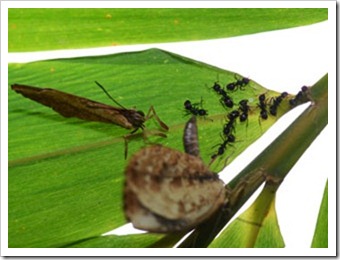
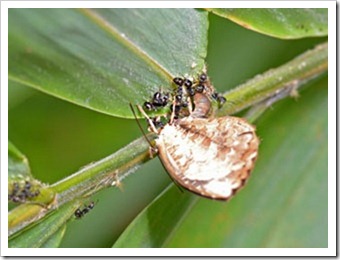
Miletus gallus gallus-MYFH_20110807_N135Miletus gallus gallus-KKBReservoir-MYFH_20110807_N150Miletus gallus gallus

The lycaenid was later identified as Miletus gallus gallus.